The Equation of Money… and the Equation of Baraka
What If You Are Solving the Wrong Equation?
 Bouazza Ayyoub6 minute read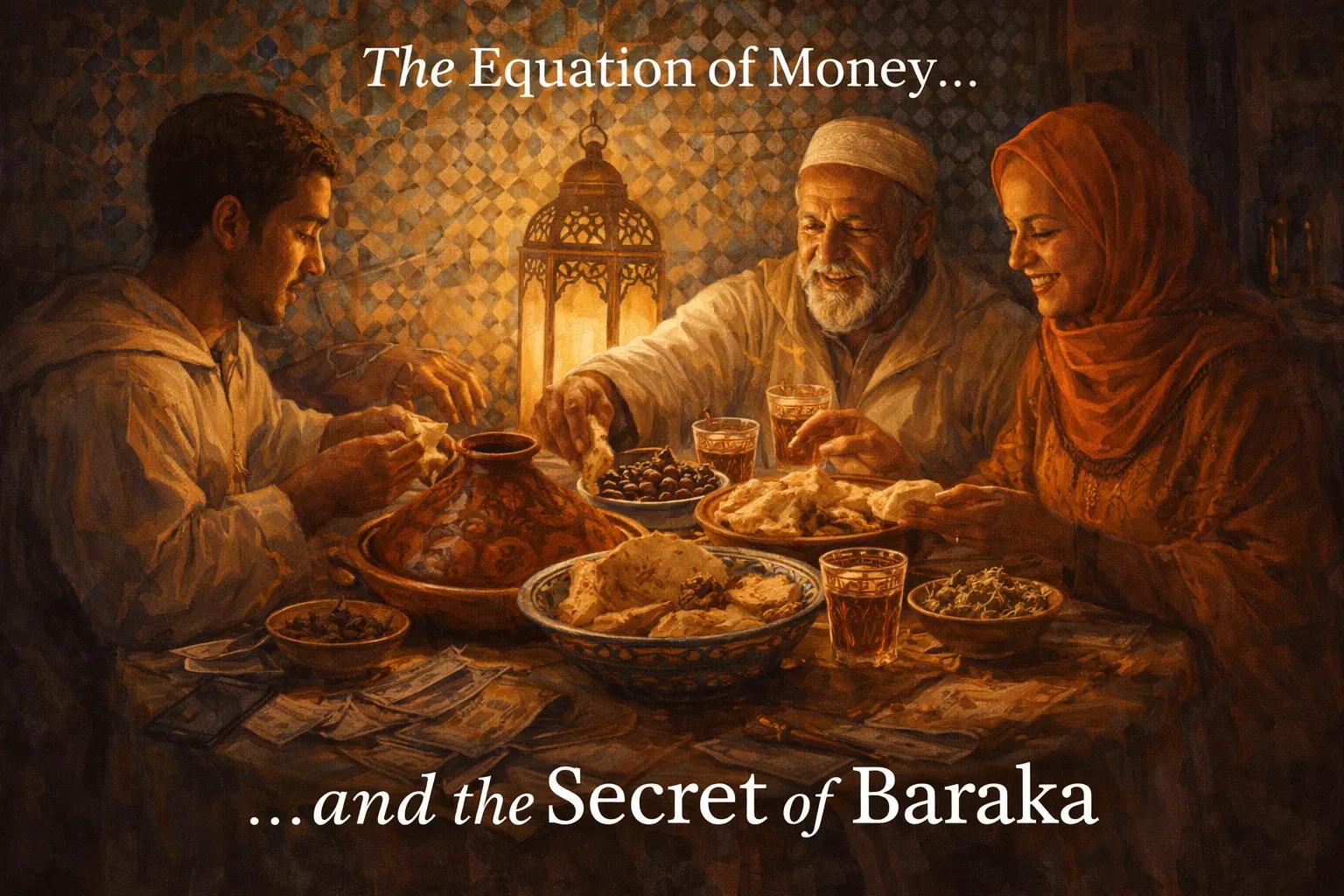
The Question Nobody Asks
What If You Are Solving the Wrong Equation?
Money is everywhere in our conversations.
In cafés, where friends compare salaries between sips of coffee. At family dinners, where the first question is often “So, what are you earning now?” On buses filled with tired students and workers, each one quietly carrying the same weight — the feeling that they are not quite where they should be yet.
Everyone is trying to solve the same equation: How do I make more money?
It is not a bad question. It is a human one. But it is incomplete.
Because beneath it — quieter, more patient, rarely spoken aloud — lives a deeper question. One that our grandparents understood instinctively, that our traditions have always carried, but that modern life has slowly drowned out with noise:
What if money was never the real equation to begin with?
This is not an article about rejecting money, or romanticizing poverty, or pretending that bills do not exist. It is about something older and more honest — a concept that generations of Moroccan families built their lives around, without ever needing to define it.
It is about Baraka.
Eating Alone
Our grandparents lived with less money… but somehow with more peace.
They rarely ate alone. Even a simple meal of bread and olive oil could become a small gathering. A neighbor passing by would be invited in. A stranger could become a guest. There was no occasion needed, no planning required — just an open door and a shared table.
Because food, at that time, was never only about hunger. It was about connection and about baraka.
Today, many of us eat alone — in front of a glowing screen, tasting without savoring, chewing without noticing. Or inside a silent apartment, surrounded by a crowded city.
There is more food now. More variety, more abundance, more options than our grandparents could have imagined.
And yet — less baraka.
Something invisible has slipped away. And no raise in income, no new restaurant, no food delivery app seems capable of bringing it back.
When Money Becomes the Master
Money was meant to be a tool. But slowly, quietly, it became a goal — and there is a rule of life that few talk about:
If you don’t use money for good, money will use you for something else.
It begins subtly. You start chasing numbers instead of meaning. Comparing lifestyles instead of building a life. Running faster and faster without ever asking where you are going.
From the outside, it looks like success. Like you have accomplished something real. But from the inside, it feels strangely, inexplicably empty.
A friend of mine lived in Casablanca for years — a city that pulses and pushes, that hums with ambition and noise. He worked hard. He stayed busy. But something about the city’s energy whispered to him constantly: you are not enough yet, keep going, keep producing. He called what he was building “fake achievement” — motion disguised as progress, busyness mistaken for purpose.
So he left. He moved to a quieter city. And now, one of his favorite things is simply riding a bicycle along the beach — not to get anywhere, not to achieve anything. Just to exist, to breathe, to feel alive.
That shift did not come from earning more. It came from wanting less of the wrong things.
Because money can buy comfort — but it cannot buy baraka.
And without baraka, even abundance can feel poor.
Happiness Is Not for Sale
Many people carry a secret belief, rarely spoken aloud:
“When I earn enough, I will finally be happy.”
But happiness, in our tradition, was never a number to reach. It was never a salary, a balance, or a milestone. It was a state of the heart, interior, independent of what you owned.
It looked like gratitude for what was already there. A simple meal shared with people you love. A quiet prayer before the world woke up. A mother’s dua whispered in the dark, heard by no one but God.
These things cost nothing. And yet they carried everything.
You can have very little — and feel profoundly full. You can have everything the world calls success — and lie awake feeling hollow.
Because money was never built to carry the weight of a soul. It cannot hold your longing, answer your deepest questions, or fill the silence that material things leave behind. It was designed for transactions — not transformation.
And no transaction, however large, has ever bought a single moment of true peace.
You Are Not Meant to Chase Money
Perhaps the greatest misunderstanding of our time is this:
You were never supposed to make money. You were supposed to build.
Build skills that outlast any economy. Build relationships that hold when everything else shakes. Build something genuinely useful — something people need, something that solves a real problem, something that would be missed if it disappeared. Build a life that still makes sense on the days when the money is gone.
Money is only a shadow of value. It follows real worth the way a shadow follows a person — faithfully, automatically, without needing to be chased.
But here is what no one tells you: a shadow has no substance of its own. You cannot hold it. You cannot build with it. You cannot feed your soul on it.
When the value is real, the shadow follows. When you chase the shadow directly, you run forever and arrive nowhere.
And somewhere along the way, you forget what you were actually trying to build.
The Equation That Truly Matters
There are two equations in life — and most people only learn one.
The first is the equation of money: Work. Earn. Spend. Repeat. Clear. Logical. Endless. It keeps you moving, but it never tells you where you are going.
The second is the equation of baraka: Give. Share. Be grateful. Feel peace. Invisible. Quiet. Eternal. It does not show up on a bank statement — but you feel it in your home, at your table, in the way you sleep at night.
One fills your pocket. The other fills your life.
And if you walk the countryside, sit at enough family tables, or stay quiet long enough after Maghrib prayers, you start to notice something. The people who truly lived well were not always the richest. They were the ones whose days were touched by baraka. Who gave without calculating. Who ate with others. Who built things that mattered beyond money?
A Moment to Pause
Before you move on to the next thing — the next scroll, the next task, the next goal — sit with these questions for a moment. Not to answer them quickly, but to let them stay with you.
- When was the last time you ate a meal slowly, with people you love, without looking at your phone?
- When was the last time you gave something — your time, your attention, your resources — without expecting anything in return?
- Are you building a life?
- If your income disappeared tomorrow, what would remain? What have you built that money cannot take away?
- Who in your life carries baraka — that quiet peace, that invisible fullness and what do they do differently than everyone else?
- Are you chasing something? And if you stopped — truly stopped — do you know what you actually want?
These are not comfortable questions. They are not meant to be. Because the life you truly want is probably not far from where you already are — it is just buried under urgency, comparison, and noise.
Baraka is not reserved for saints or scholars. It is not a reward for the perfect or the wealthy. It is available to anyone who slows down enough to receive it — anyone who gives, shares, stays grateful, and builds with intention.
HAPPY READING!
Share article
- Philosophy
- Personal Growth
- Minimalism