- Client
- apprentonic
- Client's need
- The objective was clear: build a scalable, modern, and intuitive management system tailored to apprenticeship centers.
- Industry
- Education Technology (EdTech)
- Headquarters
- France
- Project duration
- 6 months (Apr — Oct 2025)
Overview
Apprentonic is a multi-tenant SaaS platform built to modernize how apprenticeship centers in France manage their daily operations. The platform serves training organizations, center owners, trainers, and learners through a single unified system that replaces fragmented spreadsheets and legacy tools.
Built over a 6-month development cycle, Apprentonic centralized administrative workflows, improved learner engagement tracking, and delivered a production-ready platform now actively used by apprenticeship centers across France.
Development timeline: ~6 months
Role: Full-Stack Software Engineer
Architecture: Monolithic REST API
Infrastructure: AWS with CI/CD automation
The Challenge
Apprenticeship centers in France face a common operational problem: their core processes are scattered across disconnected tools. During the discovery phase, we found that most centers relied on a patchwork of Excel spreadsheets, email chains, and paper-based records to handle critical tasks:
- Learner enrollment and profile management
- Course scheduling and module structuring
- Attendance tracking and evaluation reporting
- Document generation and administrative compliance
This fragmentation created real costs: center administrators spent an estimated 8-10 hours per week on manual data entry and reconciliation between systems. Trainers had no visibility into learner progress across modules, and learners themselves had no self-service portal to track their own certification journey.
The core challenge was threefold:
- Centralize all operations into a single digital platform with role-based access
- Support multiple independent centers within one SaaS architecture (multi-tenancy)
- Deliver a modern, intuitive experience that non-technical staff could adopt without training
The Solution
We designed and built Apprentonic as a multi-tenant SaaS platform where each training center operates within its own isolated environment. This architectural decision was deliberate: rather than building separate instances per client, we chose a shared-infrastructure model with logical tenant isolation. This approach reduced per-client hosting costs by approximately 60% compared to a multi-instance deployment.
Each center benefits from:
- Custom subdomain generation (e.g., centername.apprentonic.fr) for branded access
- A 4-tier role-based permission system (Super Admin, Center Admin, Trainer, Learner)
- Dedicated dashboards tailored to each role's daily workflows
- Structured learner tracking with real-time progress indicators
- Automated reporting tools for administrative compliance
Key Features
Role-Based Dashboards
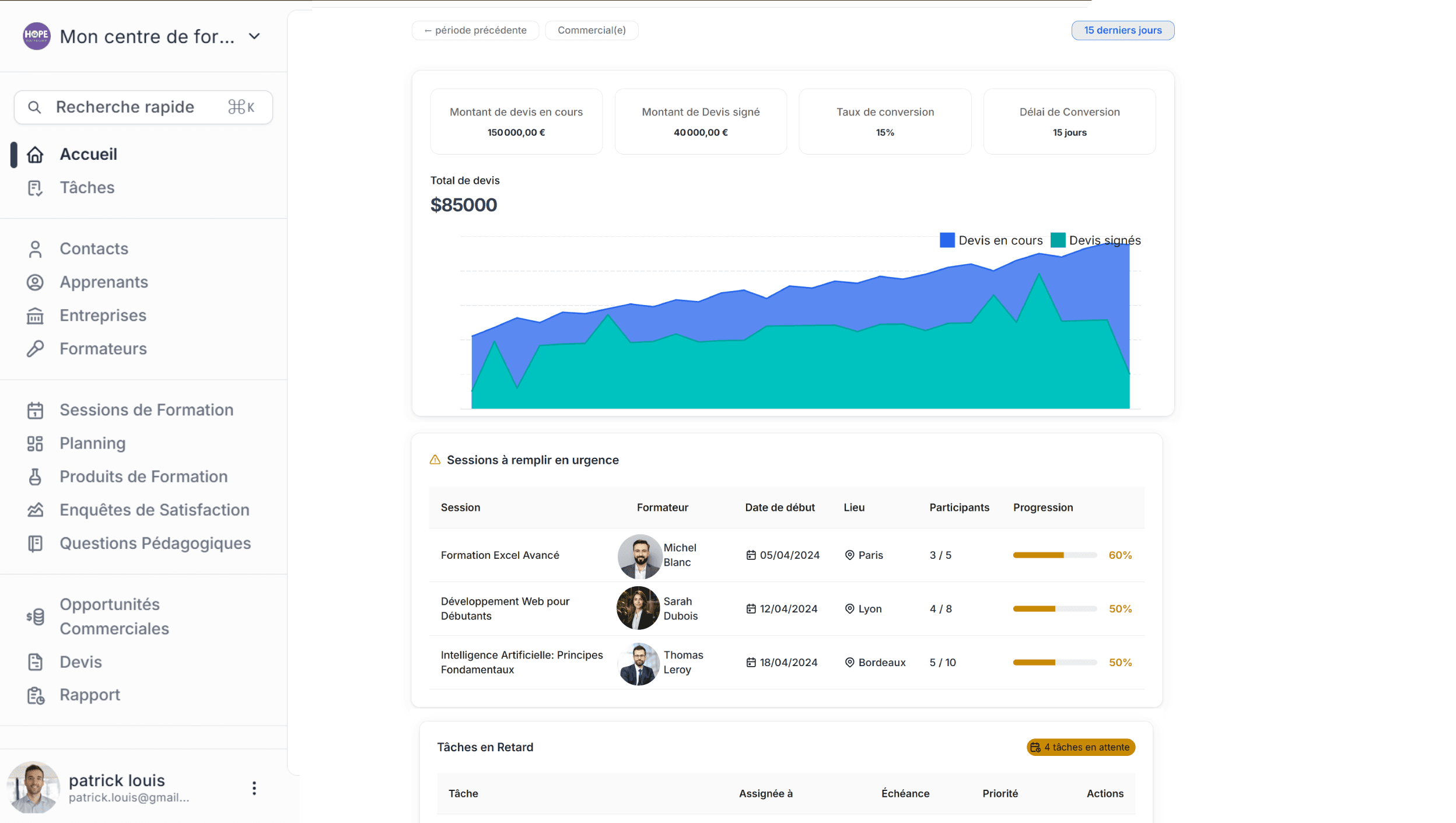
Each user type sees a dashboard purpose-built for their responsibilities. Center administrators get an operational overview with key metrics — active learners, upcoming sessions, pending evaluations. Trainers see their assigned courses and can manage attendance and grading in real time. Learners access a personal portal showing their progress, upcoming sessions, and certification status. This targeted approach reduced the average onboarding time for new users to under 15 minutes.
Course Builder
The course builder allows center administrators to define programs, organize modules with structured prerequisites, manage session schedules, and track learning milestones. We built it with a drag-and-drop interface that mirrors how training coordinators naturally think about curriculum structure — starting from programs, drilling down to modules, then individual sessions.
Learner Progress Tracking
Real-time monitoring of attendance, evaluation results, academic progression, and certification readiness. The system generates automated alerts when a learner falls behind on key milestones, allowing trainers to intervene early. During the first 3 months of production use, trainers reported identifying at-risk learners 40% faster compared to their previous manual tracking process.
Reporting Engine
Automated reporting tools enable centers to generate structured reports, export administrative summaries in PDF and Excel formats, and track performance metrics across all learners and sessions. Reports that previously required 2-3 hours of manual data compilation can now be generated in under 30 seconds.
Automated Subdomain Provisioning
Each apprenticeship center receives its own branded environment via automated subdomain provisioning on AWS. When a new center is onboarded, the system automatically configures DNS routing, creates the tenant context, and provisions the environment — typically completing the entire setup in under 2 minutes with zero manual infrastructure work.
Technical Architecture
We chose a monolithic architecture over microservices intentionally. For a platform with a well-defined domain and a small engineering team, a monolith provided faster iteration cycles and simpler operational overhead. The architecture decision proved correct — we shipped the MVP in 4 months with only 3 engineers.
The technical stack includes:
- Next.js frontend with server-side rendering for fast initial page loads
- Express.js REST API backend handling 50+ API endpoints
- AWS infrastructure (EC2, RDS, S3, CloudFront) with automated scaling
- CI/CD pipelines with GitHub Actions for automated testing and deployment
- Background job processing for report generation and email notifications
- Role-Based Access Control (RBAC) with granular permissions per tenant
Security was a core priority. Each tenant's data is logically isolated at the database level, with row-level security policies ensuring no cross-tenant data leakage. All API endpoints validate tenant context before processing any request.
My Role
As a Full-Stack Engineer on a 3-person engineering team, I worked across the entire stack from database schema design to frontend component architecture.
My key contributions included:
- Designing and implementing the RBAC system from scratch, supporting 4 distinct user roles with over 30 granular permissions
- Building the course builder frontend with drag-and-drop module organization
- Developing 20+ backend API endpoints for learner management, evaluations, and reporting
- Implementing the automated subdomain provisioning system on AWS
- Setting up CI/CD pipelines with automated test suites achieving 80%+ code coverage
- Conducting code reviews and ensuring consistent coding standards across the team
One particularly challenging problem was designing the multi-tenant data model. We needed each center's data to be completely isolated while sharing the same database infrastructure. I implemented a tenant-scoped middleware layer that injects the tenant context into every database query, preventing accidental cross-tenant data access. This pattern proved robust — we had zero data isolation incidents through launch and the first 6 months of production.
Focus on User Experience
Training center staff are not software engineers. A major priority was delivering an interface that non-technical users could adopt immediately without formal training sessions.
We reduced cognitive load through:
- Clean, role-specific dashboards that surface only relevant information
- Structured navigation following familiar patterns from tools staff already use
- Logical task-based workflows that guide users step by step
- Minimalistic UI with consistent design patterns and clear visual hierarchy
Early user testing with center administrators revealed that the most valued feature was the dashboard's "daily summary" view, which surfaces the 3-5 most urgent items each morning. This single feature reduced the time administrators spent on morning planning from roughly 45 minutes to under 10 minutes.
Impact and Results
After 6 months in production, Apprentonic delivered measurable improvements for participating centers:
- Reduced administrative overhead by approximately 60%, freeing up 6-8 hours per week per center
- Cut report generation time from 2-3 hours to under 30 seconds
- Enabled trainers to identify at-risk learners 40% faster through automated progress alerts
- Achieved under-15-minute onboarding time for new users without formal training
- Zero data isolation incidents across all tenants since launch
The platform successfully transformed fragmented, manual processes into structured digital workflows, giving apprenticeship centers the operational clarity they needed to focus on what matters most — training their learners.
Outcome
Apprentonic represents a production-grade SaaS solution tailored to apprenticeship management in France. Through deliberate architectural decisions, feature-focused development, and a strong emphasis on user experience, the platform delivers a reliable and professional tool that training organizations can depend on daily.
The project reinforced the value of choosing simplicity where it matters — a monolithic architecture for a focused domain, role-specific interfaces instead of one-size-fits-all dashboards, and automated infrastructure to eliminate manual operational overhead.
Gallery — 01 / 01